Images of Temple of San Biagio
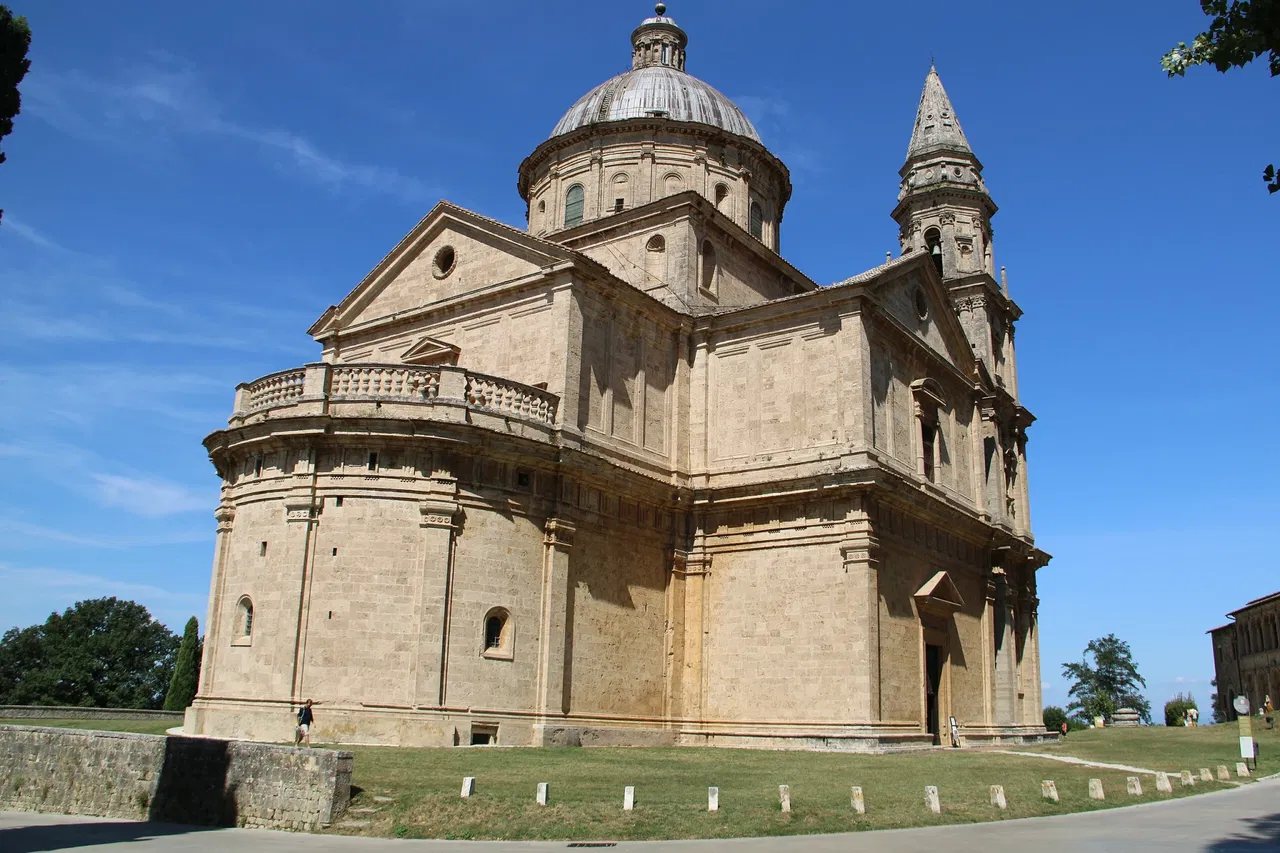

The Church of Madonna di San Biagio, located approximately a kilometer southwest below the city fortification of Montepulciano, is recognized as one of the most impressive central buildings of the Tuscan Renaissance. It is situated in an open field at the end of a cypress avenue and served as a pilgrimage church. The church, dedicated to Saint Blaise, was built from travertine between 1519 and 1540 based on the designs of Florentine architect Antonio da Sangallo the Elder.
The Church of Madonna di San Biagio is built on the blueprint of a Greek cross, with the crossing covered by a dome. The only decoration in the base floor are Doric pilasters. The entrance portals are crowned by massive triangular gables. In the floor above, these elements are repeated in Ionic order. Above this, on all four cross arms, are triangular gables each with a simple oculus in the middle.
The interior of the Church of Madonna di San Biagio has an almost square floor plan, which is only extended by four short transepts. The protruding apse outside is 'pinched' inside, creating the impression of a uniform central room. When looking into the dome area, it becomes apparent that the drum floor is structured inside just like outside, another indication of the reference of church architecture to the decoration forms of classical ancient architecture.
Via di San Biagio 14, Montepulciano
No exhibitions in Temple of San Biagio have been found.
Temple of San Biagio has 1 rating.
The Temple of San Biagio in Montepulciano, Italy, is a Renaissance masterpiece that stands out for its architectural beauty and historical significance. Located just outside the city walls, this 16th-century church offers visitors a blend of art, history, and spirituality.
The exterior of the church impresses with its symmetrical design and the use of travertine stone, which gives it a luminous appearance, especially during sunset. The dome and bell towers create a striking silhouette against the Tuscan landscape.
Inside, the church's spacious interior features a Greek cross plan, typical of Renaissance architecture. While some visitors note that the interior is relatively plain compared to more ornate Italian churches, others appreciate its elegant simplicity. The frescoes and artworks, though not as abundant as in some other Italian churches, are of high quality and add to the serene atmosphere.
Many visitors highlight the panoramic views of the surrounding Tuscan countryside from the church grounds. This picturesque setting enhances the overall experience and provides excellent photo opportunities.
On the downside, some visitors mention that the church can be a bit of a walk from the town center, which might be challenging for those with mobility issues. Additionally, a few reviewers note that the opening hours can be limited or inconsistent, so it's advisable to check in advance.
Overall, the Temple of San Biagio is highly regarded for its architectural significance, historical value, and the peaceful atmosphere it offers. It's considered a prime example of Renaissance architecture and a testament to the artistic achievements of its time.
This rating is based on the rating of this museum on several other platforms.
Discover museums near Temple of San Biagio in or around Montepulciano.