
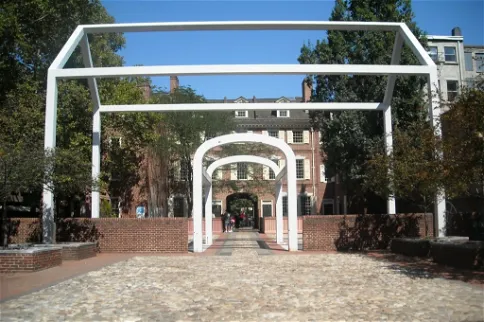
At Franklin Court in Philadelphia, steel frames hover above the ground like architectural ghosts, outlining a house that hasn't existed for two centuries.
Welcome to one of America's most inventive historical sites, where you can explore Benjamin Franklin's final home without actually seeing it.
This unique complex in Independence National Historical Park offers something truly different: instead of a typical reconstruction, you'll find a thought-provoking blend of archaeology, modern architecture, and interactive storytelling that captures Franklin's innovative spirit in its very design.
A Home Built, Lost, and Reimagined
Benjamin Franklin built his Philadelphia residence in 1763 within a large courtyard accessed through an alleyway from Market Street. Though his diplomatic work kept him overseas for years, Franklin called this place home during the pivotal moments of the Constitutional Convention, finally moving in permanently in 1785.
He died here in 1790 at age 84. In 1787, he had built a print shop on the property for his grandson Benjamin Franklin Bache, who published the Aurora newspaper there. The house was demolished in 1812 during redevelopment, and its exact appearance remained uncertain for over 150 years until National Park Service archaeologists began excavating in the 1950s and 60s.
Interactive Exhibits and Working Demonstrations
The underground Benjamin Franklin Museum explores five character traits that defined Franklin: ardent and dutiful, ambitious and rebellious, motivated to improve, curious and full of wonder, and strategic and persuasive. Each room features touchscreen displays, mechanical interactives, films, and original artifacts that bring these qualities to life.
The working Printing Office contains reproduction 18th-century presses where park rangers demonstrate typesetting and printing techniques. You'll see the newspaper office that once belonged to Franklin's grandson, complete with a bindery and typesetting area where the craft of colonial-era printing comes alive through hands-on demonstrations.
The Ghost Structures That Changed Museum Design
The site's most striking features are the steel "ghost structures" designed by architects Venturi and Rauch for the 1976 Bicentennial. These tubular steel frames rise 50 feet high, tracing the outline of Franklin's demolished house and print shop where they once stood.
This innovative solution emerged from a problem: insufficient historical evidence existed to accurately rebuild the structures. The design became influential in historic preservation, offering a way to honor lost buildings without falsely reconstructing them. Below the frames, you can peer through viewing portals to see the actual archaeological remains of Franklin's home, creating a powerful connection between past and present.
Fragments of Franklin Court Highlights & Tips
- The Ghost Structure Frames Walk beneath the striking steel outlines that trace Franklin's lost house and print shop, offering a modern architectural interpretation of historic preservation.
- Archaeological Viewing Portals Look down through concrete viewing hoods to see the actual foundations and remains of Franklin's 18th-century home beneath your feet.
- Underground Museum Experience Explore five themed rooms in the Benjamin Franklin Museum with interactive exhibits, touchscreens, and artifacts showcasing Franklin's multifaceted genius.
- Live Printing Demonstrations Watch park rangers operate reproduction 18th-century presses and demonstrate the typesetting techniques Franklin would have used.
- Part of Independence National Historical Park Franklin Court is within walking distance of Independence Hall, the Liberty Bell, and other historic sites. Plan a full day to explore the entire park.
- Access Through the Alleyway Enter from Market Street through the same narrow passage Franklin's visitors would have used to reach his secluded courtyard home.
- Best for History and Architecture Enthusiasts This site appeals particularly to those interested in innovative museum design and the intersection of archaeology with contemporary architecture.
- Working Post Office The complex includes a functioning postal museum where you can mail letters with a special Franklin Court postmark.
Franklin Court represents a bold experiment in how we remember and interpret history. Rather than offering a polished recreation, it presents honest fragments and thoughtful questions about the past.
The steel frames standing against Philadelphia's sky remind us that history isn't always complete or certain, but remains worth exploring. Whether you're drawn by Franklin's legacy, innovative architecture, or the challenge of reimagining lost spaces, this site rewards curiosity with its unique approach to bringing the past into conversation with the present.


