
Step inside a gleaming relic of the Space Age, where 1960s optimism meets cutting-edge interactive science in one of Queens' most distinctive landmarks.
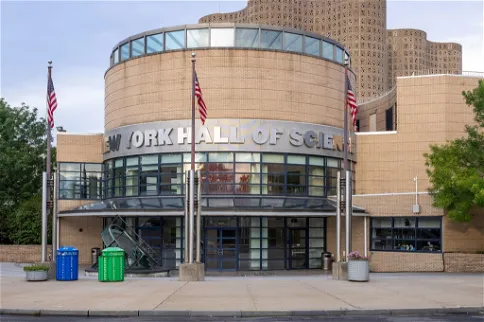
Welcome to the New York Hall of Science, where history and hands-on learning collide in spectacular fashion. Housed in one of the few surviving structures from the 1964 World's Fair, this Queens institution stands as both a monument to mid-century American ambition and a thoroughly modern science center.
With over 400 interactive exhibits spanning biology, chemistry, and physics, NYSCI invites visitors to touch, experiment, and discover. From real spacecraft in Rocket Park to the physics playground outside, this is science education that breaks free from behind glass cases and puts discovery directly in your hands.
From World's Fair Pavilion to Science Landmark
The museum's iconic curved concrete structure was designed by Wallace K. Harrison for the 1964 New York World's Fair, opening as the fair's Hall of Science pavilion that June. When most fairground buildings were demolished, this architectural marvel survived, reopening as a permanent museum in September 1966.
The journey wasn't always smooth. Financial struggles forced closures in the 1970s and early 1980s. The turning point came in 1984 when physicist Alan J. Friedman took the helm, transforming the museum into an interactive wonderland. Under his leadership through 2006, NYSCI pioneered hands-on science education, expanding with new wings in 1996 and 2004 while carefully restoring Harrison's original Great Hall between 2009 and 2015.
Interactive Exhibits That Invite Exploration
NYSCI's permanent collection focuses on experiences rather than artifacts behind glass. The iconic Mathematica exhibit by Charles and Ray Eames demonstrates mathematical principles through elegant mechanical displays. Hidden Kingdoms brings microbiology to life with microscopes and aquariums, while the Pfizer Biochemistry Discovery Lab offers 12 hands-on experiments.
The Great Hall showcases Connected Worlds, an immersive digital ecosystem where visitors' actions affect virtual environments. A genuine Mercury space capsule hangs from the ceiling in the original building, which staff believed was a replica for four decades. The north wing's Human Plus exhibit explores assistive technology, while CityWorks, added in 2025, reveals the hidden infrastructure keeping New York running.
Where Science Breaks Free Outdoors
What sets NYSCI apart is how science spills beyond its walls. Rocket Park displays towering Atlas and Titan II rockets from the 1964 fair, 102 and 110 feet tall respectively, that were built for Cold War defense but found new life as educational monuments.
The 60,000-square-foot Science Playground transforms physics into pure joy with wobbly bridges, massive seesaws, water tables demonstrating Archimedes' principles, and musical instruments teaching sound science. A nine-hole mini-golf course sneaks lessons about momentum and angular velocity into family fun. It's science you can climb, splash through, and genuinely play with, all against the backdrop of Harrison's striking 1960s architecture.
New York Hall of Science Highlights & Tips
- The Great Hall's Architectural Drama Marvel at the 80-foot-high curved concrete walls studded with 5,400 blue glass rectangles, a stunning example of 1960s space-age architecture that creates one of New York's most breathtaking interiors.
- Real Rockets from the Cold War Stand beneath genuine Atlas and Titan II rockets in Rocket Park, towering testaments to the Space Age that were rebuilt and restored in 2003 after decades of weathering in Queens.
- Mathematica Exhibit Experience the legendary Charles and Ray Eames installation from 2004, demonstrating mathematical principles through beautiful mechanical displays that have captivated generations of visitors.
- Science Playground Adventures Let kids (and adults) explore physics through climbing structures, water experiments, giant seesaws, and musical installations in the outdoor playground, open March through December.
- Getting There by Subway Take the 7 train to 111th Street station or the Long Island Rail Road to Mets-Willets Point. The museum is located in Flushing Meadows-Corona Park at 47-01 111th Street.
- Plan for Hands-On Time With over 400 interactive exhibits, allocate at least 3-4 hours to truly engage with the museum. College student explainers are stationed throughout to help demonstrate scientific concepts.
- Science Playground Requires Extra Admission The outdoor Science Playground and mini-golf course charge separate fees beyond museum admission. Both are worth the investment for families with children ages 6 and up.
- Check for Special Events NYSCI hosts seasonal events including Maker Faire (formerly held annually through 2019), eclipse watch parties, and summer programming. Visit their website for current offerings.
- Explore the Park The museum sits within Flushing Meadows-Corona Park, home to the Unisphere and other World's Fair remnants. Combine your visit with a walk through this historic landscape.
The New York Hall of Science stands as living proof that the best museums evolve without forgetting their roots. Harrison's soaring concrete curves still inspire wonder, while the exhibits inside have transformed from static displays into dynamic laboratories of discovery.
Whether you're watching kids grasp physics concepts on the playground, standing beneath Cold War rockets, or exploring the latest interactive installations, NYSCI delivers science as it should be: engaging, accessible, and utterly hands-on. This is where New York's World's Fair dreams of tomorrow became today's reality, and where every visitor becomes a scientist, one experiment at a time.


