Exhibition 'Andrzej Steinbach - Hier' in Huis Marseille, Museum for Photography
In October 2026 Huis Marseille will be introducing the Netherlands to the work of Andrzej Steinbach. Early on in his career Steinbach developed his own visual language, with meticulously planned compositions and almost Spartan settings. The exhibition title Hier (Here) can be read as an invitation: his works are gestures of showing. Their austerity helps to isolate patterns, whether these concern small details or larger social structures, and creates space to consider the mechanisms behind the act of looking. Steinbach treats seeing itself as an aesthetic problem. Rather than resolving it, his art gives the problem a form that can be admired, so that it can be attended to elsewhere.
Figures
Andrzej Steinbach constructs his images like a director: ‘there has to be a scratch on the surface here’ and ‘your hand has to be here’. His models follow his instructions closely, bringing subtle variations in gesture, posture, or outfit. Their invariably neutral expressions offer no insight into their personalities. Steinbach simply calls them ‘figures’. He uses these figures, the backgrounds, and the compositions to form typologically structured series that aesthetically explore the process by which we attribute meaning, roles and types to what we see, even when much information is withheld.
Society begins with three
The series Gesellschaft beginnt mit drei (2017) examines role assignments amongst people. Three figures perform a choreography of changing poses, formations and clothing, making their group dynamic subject to constant change. Its title refers to the argument that an interplay of forces among three elements underlies most structures, including, ultimately, society itself. In almost every photo in Gesellschaft beginnt mit drei, only three eyes can be seen: one of the faces has been cut in half. Together, the images blend to form a group portrait full of inconsistencies.
Mayakovsky’s pose
These inconsistencies are intentional; Steinbach often exposes photographic conventions by subtly breaking them. In a key work, he has a builder recreate the pose of the poet Vladimir Mayakovsky in a famous 1924 photograph by Alexander Rodchenko: sideways on a chair, and leaning slightly forward, the figure looks at the camera with an unwavering gaze. A construction helmet replaces Mayakovsky’s fedora, while a vape takes the place of his cigarette. Detached from its context, the pose ceases to function as an expression of individuality and instead emerges as a culturally inherited gesture that can be inhabited by another body.
Extending humans
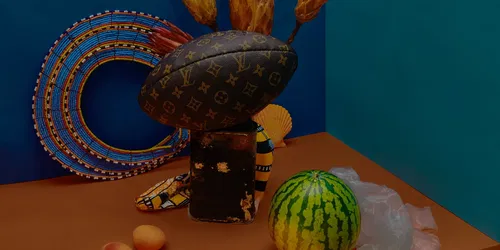
In the newest series Erweiterungen (2024), figures pose with practical implements. The title refers to the idea that we make objects as extensions of our own bodies. In Steinbach’s photos a sleeping bag helps with skin temperature regulation, a mirror enlarges the field of view, and a sewage pipe functions as an extension of the intestines. In one photo, no object at all can be seen: however, purposeful hand gestures point to something that remains invisible.
Auto Erotik
Steinbach’s practice is driven by a sense of fascination with complex ‘problems’ and a love of form. Perhaps as a result, his titles often refer to social theories, while his images contain references to images from the history of photography. His series Auto Erotik (2022), with dynamic close-up photos of screws and tools, puts one in mind of the ‘machine aesthetic’ that was popularised by the Neues Sehen in the 1920s, a movement that was particularly prominent among Bauhaus artists. However, whereas at that time photography celebrated the machine as a symbol of progress, Steinbach shows little of this enthusiasm. The tools show clear signs of wear and tear: dents and scratches attest to their intensive use, and Steinbach sometimes deprives a tool of its function by drilling a hole through it. Arranged together, they hold one another in a tension-filled equilibrium. In this series the artist examines how macrophotography can evoke the illusion of eroticism.
Structures that shape perception
A single photograph by Steinbach can encompass a multitude of questions, from how perspective shapes perception to the relationship between image and text and the role of photography in structuring and typologising the world. It also exposes the assumptions underlying our response to gestures, poses, outfits, or even to nothing more than ‘ordinary stones’. As viewers, we may catch ourselves in the act of making meaning. Yet Steinbach’s work presents problems that he does not resolve. Instead, his photographs leave us in a state of inquiry, unsettling the certainties that underpin our carefully ordered everyday lives.
Hier
The exhibition Hier at Huis Marseille is an adaptation of earlier presentations at the Museum für Photographie Braunschweig (2025) and the Kunsthalle Erfurt (2025–2026). Each of these three institutions made its own selection from the artist’s work of the last ten years, with a shared focus on his latest series, Erweiterungen (2024). The catalogue Extensions (Spector Books, 2026) combines this new work with other photographs, including some that appeared in Steinbach’s earlier artist’s books, creating visual links with older work while drawing attention to the ways in which photographic images are disseminated. The catalogue is available in the museum shop.
Biography
Andrzej Steinbach (1983, Czarnków, Poland) studied photography at the Hochschule für Grafik und Buchkunst (HGB) in Leipzig. His work is exhibited internationally and represented in leading museum collections including the Museum of Modern Art (MoMA, New York), the Centre Pompidou (Paris), the Fotomuseum Winterthur (Switzerland), and the Hamburger Kunsthalle, the Museum Folkwang (Essen) and the Sprengel Museum (Hanover) in Germany. He was co-director of the Briefing Room project space in Brussels (2022–2025) and now lives and works in Berlin.